


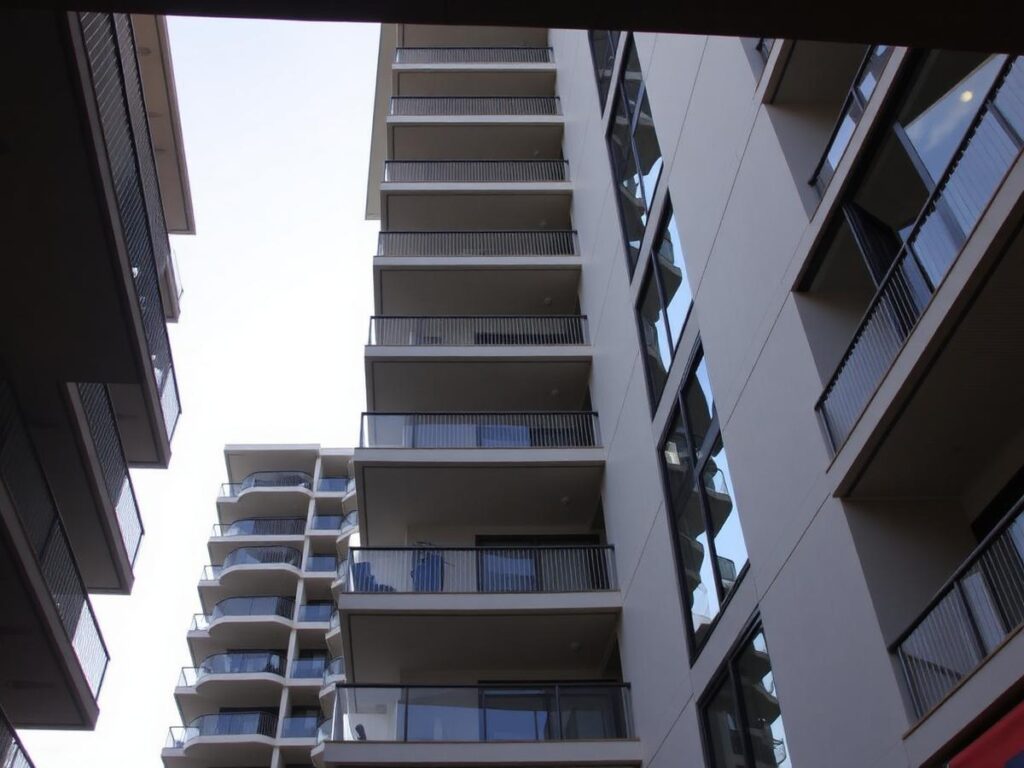
It’s one of the most common disputes that comes up at condo board meetings in the GTA: a resident notices a crack in their balcony slab, water staining on the unit below, or a wobbly railing — and nobody can agree on who’s supposed to fix it. Is a condo balcony repair the corporation’s job, or does it fall on the unit owner?
The honest answer is: it depends on your building’s declaration — but there’s a consistent legal framework underneath that determines the default answer. This guide walks through how responsibility is actually decided in Ontario, where the gray areas tend to show up, and what both condo boards and unit owners should do when a balcony issue arises. If your building is already dealing with visible damage and residents are searching “balcony repair near me” trying to figure out who to call, our balcony restoration Toronto team can provide a written condition assessment that helps clarify scope before the responsibility conversation even starts.
A quick note before we go further: this article is intended as general information for Ontario condo owners, boards, and property managers. It is not legal advice. Your specific condo declaration governs your situation, and a condo lawyer should be consulted for disputes or unusual circumstances.
The Starting Point: Common Elements vs. Unit Boundaries
Every Ontario condo operates under the Condominium Act, 1998, which divides a building into two broad categories:
- The unit — generally the interior space owned exclusively by the resident, bounded by the inner surfaces of walls, floors, and ceilings
- The common elements — everything else, which is owned collectively by all unit owners through the condominium corporation
Balconies sit in an unusual position in this framework. In many Ontario condo buildings, the balcony slab itself — the structural concrete, the waterproofing membrane, and the railing — is classified as a common element, even though it’s only accessible from one specific unit. That distinction is the reason balcony restoration GTA-wide is so frequently a corporation responsibility rather than a personal one, even though it feels like “your” balcony.
However — and this is the part that trips up a lot of boards and owners alike — this is a default, not a universal rule.
Why Your Declaration Is the Real Answer, Not the Act Itself
The Condominium Act sets out general principles, but the specific document that actually governs your building is its declaration. Some declarations designate balconies as common elements in their entirety. Others designate them as exclusive-use common elements, meaning the corporation still owns the structure, but the unit owner has exclusive use of it and may be responsible for certain maintenance obligations, like keeping it clean or not overloading it. A smaller number of declarations go further and assign specific repair obligations — such as surface coatings or railings — directly to the unit owner.
This is why two condo owners in different buildings, with what looks like an identical balcony problem, can get completely different answers about who’s responsible. The first step in any balcony repair dispute should always be pulling out the declaration, not assuming based on what a neighbour’s building does.
What’s Typically the Corporation’s Responsibility
In most standard condo declarations across the GTA, the following generally fall to the condominium corporation:
- Structural integrity of the balcony slab
- Balcony waterproofing in Toronto buildings — membrane systems and drainage
- Railing structural stability and anchoring
- Concrete repairs related to spalling, cracking, or rebar corrosion
- Any repair required to bring the balcony into compliance with the Ontario Building Code
This makes sense from a risk-management standpoint — structural failure or a collapsed railing is a life-safety issue that affects the whole building, not just one unit. Corporations typically carry the insurance and reserve fund obligations tied to these repairs, which is part of why proactive capital planning and condition assessments matter so much for boards. Boards evaluating balcony waterproofing failures specifically should treat membrane deterioration as a corporation-level structural issue rather than a cosmetic one, since delayed waterproofing repairs are one of the fastest ways a moderate issue turns into a major one.
What’s Typically the Unit Owner’s Responsibility
Depending on the declaration, unit owners are often responsible for things that don’t affect the building’s structural integrity, such as:
- Personal furniture, planters, or décor on the balcony
- Keeping the balcony clean and free of debris that could clog drains
- Cosmetic surface finishes the owner installed themselves (like interlocking tiles or artificial turf) rather than the original building finish
- Damage caused by the owner’s own negligence — for example, an improperly installed satellite dish that penetrates the waterproofing membrane
The key distinction is usually this: if the issue affects the original structure, membrane, or life-safety component, it tends to be the corporation’s problem. If it’s something the owner added, modified, or damaged through their own actions, it tends to fall on them.
Where the Gray Areas Actually Show Up
Most disputes don’t happen in the clear-cut cases — they happen in the overlap. A few common examples:
Glass railing systems. Some buildings treat glass panels as part of the common element structure, while others consider cracked or scratched glass a cosmetic issue closer to the unit owner’s exclusive-use responsibility. This varies significantly by declaration.
Surface coating vs. structural membrane. A worn decorative coating might be considered a cosmetic, owner-adjacent item, while the waterproofing membrane underneath it is almost always a structural, corporation-level repair. The challenge is that these two things often need to be addressed together, which is why a proper structural repair assessment matters — it identifies where the cosmetic issue ends and the structural issue begins.
Damage from something the owner installed. If an owner drilled into the slab to install a privacy screen and that penetration is now the source of a leak, the corporation may reasonably argue the resulting membrane damage is the owner’s responsibility, even though membrane repair is normally a common element item.
Negligence versus normal wear. Freeze-thaw cracking and membrane aging are considered normal deterioration and are typically the corporation’s responsibility. Damage caused by an owner’s actions — leaving standing water to freeze repeatedly in one spot, for instance — can shift liability depending on the specifics.
What Happens When Damage Is Caused by Negligence
If a balcony repair is needed because of something a unit owner did — rather than normal wear and structural aging — many declarations allow the corporation to charge the cost of repair back to that specific owner, sometimes by adding it to their common expense contribution. This is one of the more contentious areas in condo governance, and it’s usually where legal counsel gets involved if the owner disputes the charge-back.
Insurance Considerations
Both the condominium corporation’s master insurance policy and an individual owner’s unit policy typically play a role here, and the split often mirrors the same corporation-versus-unit-owner line described above. Structural common element repairs are generally addressed under the corporation’s master policy, while damage to an owner’s personal property on the balcony — furniture, planters, and so on — would typically fall under the owner’s own policy. Because coverage details vary by policy and by declaration, this is another area where getting specifics in writing before a dispute escalates saves everyone time.
What a Condo Board Should Do When a Balcony Issue Comes Up
- Pull the declaration first — don’t rely on assumption or precedent from another building
- Get a professional condition assessment to distinguish structural issues from cosmetic ones
- Document everything in writing — inspection reports, photos, and correspondence protect the corporation if a dispute later escalates
- Loop in legal counsel early if a charge-back or negligence claim is being considered
- Budget proactively through reserve fund planning rather than reacting only after a resident complaint
What a Unit Owner Should Do
- Report visible damage immediately — cracks, staining, or railing instability shouldn’t be left to “wait and see”
- Review your declaration and status certificate before assuming who’s responsible
- Avoid DIY modifications to the balcony structure, since these can shift liability if something later goes wrong
- Keep records of any communication with the property manager or board about the issue
- Request a written response from the board or management if responsibility is disputed, rather than letting it go unresolved
Final Thoughts
Balcony repair Toronto responsibility isn’t a single universal rule — it’s a combination of the Condominium Act’s general framework and the specific language in your building’s declaration. In most cases, structural elements like the slab, membrane, and railing anchoring fall to the condominium corporation, while owner-added items and owner-caused damage tend to shift toward the unit owner. When in doubt, the declaration is the document that actually answers the question, and a professional assessment is often the fastest way to separate “cosmetic” from “structural” before a dispute drags on.
Once responsibility is settled, the next question boards usually ask is what the repair itself will actually involve — we cover that in detail in our guide to balcony concrete repair cost factors in Toronto.
If your board or property management team needs a clear, written condition assessment to settle a responsibility question or plan ahead for balcony restoration Toronto or the wider GTA, our team works directly with condo boards and property managers to provide documented, engineer-informed evaluations for condo balcony repair projects of any scale.
Frequently Asked Questions
1. Are balconies considered common elements in Ontario condos?
In most standard declarations, yes — the structural slab, waterproofing membrane, and railing are typically classified as common elements owned collectively by the corporation, though this can vary by building.
2. Who pays for balcony railing repair in a condo — the corporation or the owner?
Railings are usually treated as a life-safety structural component and fall under the corporation’s responsibility, but exclusive-use provisions in some declarations can shift certain maintenance obligations to the owner. Always check your specific declaration.
3. What is an “exclusive-use common element” and how does it apply to balconies?
It’s a common element that the corporation still owns, but that one unit owner has the exclusive right to use — often with certain maintenance responsibilities attached, such as keeping the space clean or free of unauthorized modifications.
4. Can a condo corporation charge a unit owner for balcony repairs?
Yes, if the damage resulted from the owner’s negligence or unauthorized modification rather than normal structural deterioration, many declarations allow the cost to be charged back to that owner.
5. Does condo insurance cover balcony repairs?
Typically, structural common element repairs are addressed under the corporation’s master insurance policy, while an owner’s personal property on the balcony is generally covered under their individual unit policy — though coverage specifics vary.
6. What should I do if my condo board won’t address a damaged balcony?
Document the issue in writing, request a formal response referencing the declaration, and if the board still doesn’t act, consult a condo lawyer or reach out to the Condominium Authority of Ontario for guidance on next steps.
7. Is a cracked balcony considered an emergency repair?
It can be, particularly if there are signs of structural instability, exposed rebar, or railing movement. These issues should be reported and assessed promptly rather than left for a routine maintenance cycle.
8. Who is responsible for balcony repairs if I added my own flooring or furniture?
Owner-installed additions like interlocking tiles, artificial turf, or furniture are generally the unit owner’s responsibility, including any damage those additions may cause to the underlying structure.
9. How can a condo board avoid disputes over balcony repair responsibility?
Clear, proactive condition assessments and transparent communication with owners go a long way. Boards that document balcony conditions regularly and reference the declaration explicitly tend to face far fewer disputes than those that only react after a complaint.