


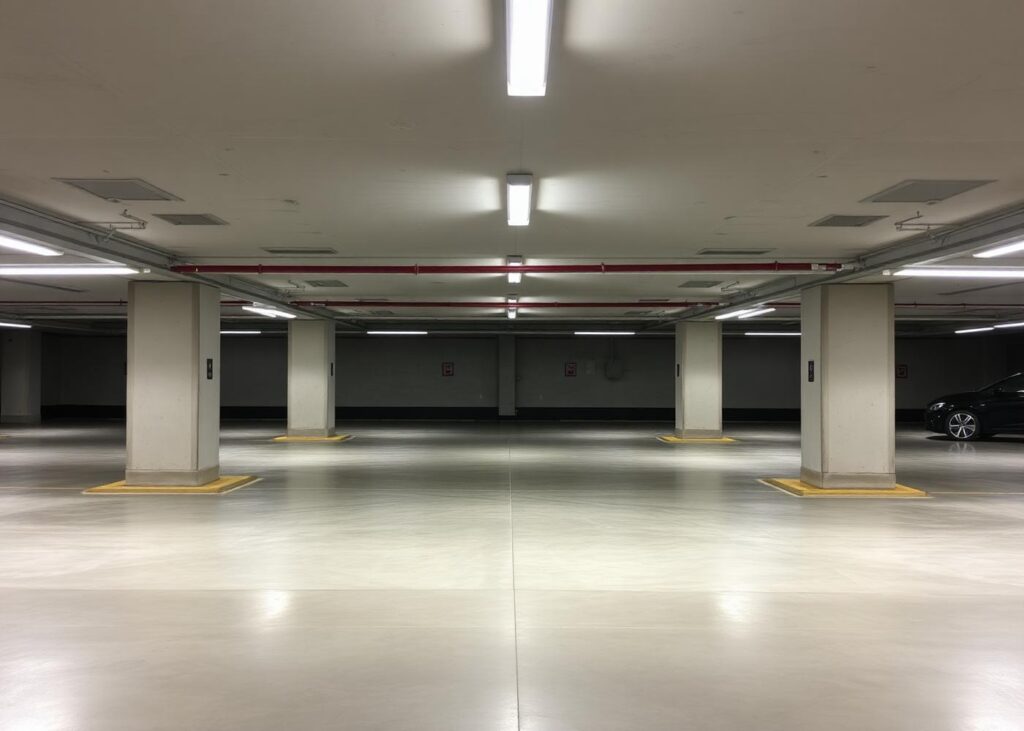
Puddles on the floor. Drips on parked cars. A damp ceiling that stains again a few months after it’s been painted. If you manage or sit on the board of a building with parking below grade, you’ve probably asked: how do I stop water leaking into my underground garage?
The short answer is that you can’t stop a leak you haven’t traced. Water can enter through the walls, the slab, the joints, the drains, or the plaza above, and each source needs a different repair.
This guide shows how to find the source, what fixes it, and what to do in the meantime. If you’re dealing with a leak now, get a quote from Kavern and we’ll start with an inspection.
Quick answer: To stop water leaking into an underground garage, identify where the water enters, then repair that source: cracks are injected, failed joints and sealants replaced, drains cleared and repaired, and failed waterproofing membranes restored. Temporary drip diverters only protect vehicles and people. A lasting fix needs an assessment, because the visible leak is often far from the entry point.
Why Does Water Leak Into an Underground Garage?
A below-grade garage has a harder job than the rest of the building. It has to stay dry while groundwater presses against its walls, and while the roof over it carries landscaping, driveways, and walkways.
Several things work against it in Ontario:
- Hydrostatic pressure: water in the soil pushes against foundation walls and slabs
- Freeze-thaw cycles: repeated freezing opens cracks and stresses joints
- De-icing salt: cars carry it in, and it speeds up corrosion of the steel inside the concrete
- Structural movement: joints and cracks shift with temperature and load
- Age: membranes, sealants, and drains wear out
Many owners don’t realize the plaza, lawn, or driveway above the garage sits on a concrete slab covered by a waterproofing membrane. It works like a second roof, and when it fails, water drips into the garage below.
How to Find the Source of an Underground Garage Leak
Where the water shows up points to where it’s coming from:
| Where you see water | Likely source | What it usually needs |
|---|---|---|
| Ceiling drips below landscaping, plaza, driveway, or sidewalk | Failed waterproofing membrane or plaza drains | Engineer assessment, then localized repair or membrane restoration from above |
| Drips at ceiling joints or slab edges | Failed expansion or control joint | Joint and sealant replacement |
| Damp or wet walls, often with white deposits | Foundation wall cracks or hydrostatic pressure | Crack injection, exterior or interior waterproofing measures |
| Water at the wall-to-floor joint or seeping through the slab | Groundwater, failed drainage, floor cracks | Crack injection, drainage repair |
| Water at the ramp entrance or garage door | Surface drainage, clogged trench drains, worn door seals | Drain cleaning and repair, regrading, new seals |
| Drips around pipes, columns, or penetrations | Failed sealant at penetrations, or a plumbing leak | Sealant repair; a plumber to confirm |
| Rust stains, white stalactite-like deposits, flaking ceiling paint | Long-term leak with steel corrosion | Concrete repair plus fixing the source |
A few clues help narrow it down:
- Timing: leaks after rain or snowmelt point to exterior water. Leaks in dry weather point to plumbing or mechanical systems.
- Location above: check what sits above the drip. Planters, irrigation, and low spots on the plaza matter.
- Staining patterns: rust stains and white mineral deposits show where water has been traveling for a long time.
Rule out plumbing early. If the leak continues in dry weather, ask maintenance to check domestic water lines, sprinkler lines, HVAC condensate, and drains before spending time on the structure.
How to Stop Water Leaking Into Your Underground Garage: Repairs by Source
Cracks in walls and slabs
Cracks are usually repaired by injection. Flexible polyurethane suits actively leaking cracks, and epoxy suits structural cracks that need bonding. The right choice depends on whether the crack is moving, whether it’s leaking now, and why it formed. That last question matters, because injecting a crack that keeps moving won’t hold.
Failed expansion and control joints
Joints exist so the structure can move without cracking. Over time the sealants and joint systems in them harden, split, and pull away. Replacing them is often one of the more direct fixes. Our caulking and sealant application team handles this kind of work.
Drains and surface drainage
Clogged trench drains, failed drain connections, and downspouts that discharge near the ramp all push water toward the garage. Cleaning, repairing drains, and correcting the grading near entrances can remove the problem at its source.
The plaza deck membrane
This is the “underground roof.” When its membrane fails, water finds every crack and joint below. Reaching it usually means removing landscaping, pavers, or pavement above, which makes it the most disruptive repair. Engineers often begin by mapping leaks and testing, then choose between localized repair and full membrane restoration.
Foundation wall waterproofing
Waterproofing applied on the outside of a wall, where the water is, works best. It also means excavating. Interior measures, such as crack injection and drainage or collection systems, can manage leaks without excavation, but they treat the water after it’s already in the wall. Your engineer will weigh the two.
For more on how these systems protect the building, read what building envelope waterproofing is and our building waterproofing service page.
Concrete and steel repair
Once water has rusted the reinforcement and flaked the concrete, the damage needs repairing too, or the leak comes back. See what causes concrete spalling in parking garages and our concrete repair and structural repair services.
Temporary protection while you plan
Drip diverters or trays over stalls, barriers around ponding, and ice management at entrances protect people and vehicles. They manage the symptom, though. They don’t stop the leak.
What Doesn’t Work
- Sealing the visible drip and stopping there: the water may simply travel to a new spot
- Painting over stains: it hides the evidence and traps the problem
- Repeated patching without a diagnosis: the same area fails again
- Ignoring leaks near electrical equipment: water and live equipment are a safety risk
- Waiting: water plus de-icing salt corrodes the steel inside the concrete
When Is a Garage Leak a Safety or Structural Concern?
Call an engineer promptly if you see any of these:
- Rust stains or exposed, corroded steel
- Concrete flaking or falling from the ceiling
- Cracks that are growing
- Ponding water near electrical panels or equipment
- Ice forming on the floor or ramp in winter
- Sagging or deflection in a slab
Step by Step: What to Do About an Underground Garage Leak
- Document it. Photograph each leak with the date and weather, and mark locations on a plan.
- Protect people, vehicles, and equipment. Use diverters and barriers, and keep clear of electrical.
- Rule out plumbing and mechanical leaks.
- Note when it leaks: after rain, after snowmelt, or in dry weather.
- Get a professional assessment. See how to get a property condition assessment done, and consider a waterproofing engineer.
- Define the repair scope, then ask contractors to quote the same scope. Our list of questions to ask before hiring a restoration contractor helps.
- Plan around residents. Think about parking access, noise, and phasing.
- Inspect again after the next thaw to confirm the repair held.
Boards often line up major garage work with their reserve fund study, which helps with timing.
Localized Repairs or Full Waterproofing Restoration?
Localized repairs
Pros
- Targeted, and less disruptive
- Fast for isolated leaks with a known cause
Cons
- The leak can reappear elsewhere if the wider system is failing
- Repeated visits over time
Full waterproofing restoration
Pros
- Addresses the whole system, not just one drip
- Consistent materials and detailing across the garage or plaza
Cons
- More planning and engineering input
- Heavier disruption, such as removing landscaping and restricting parking
The engineer’s findings usually decide it. If leaks are widespread, a full approach tends to last longer.
How Kavern Helps With Underground Garage Leaks
Kavern Building Restoration is WSIB-certified and fully insured. Our underground garage structure repairs combine concrete repair, joint and sealant work, and waterproofing, with phased execution that respects occupancy. See a completed job at 70 Spadina Road.
[Add a first-hand note here: 2–3 sentences from a Kavern project lead about a real garage leak. For example, where the water turned out to be entering compared with where it was showing, and what that changed.]
We work with engineers and architects, parking garage and podium specialists, property managers, and owners and boards. For a full overview, read our underground garage and parking structure repair guide, and see our work in Toronto and Mississauga.
Frequently Asked Questions
How do I stop water leaking into my underground garage?
Find where the water enters, then repair that source. Depending on the cause, that means crack injection, joint and sealant replacement, drain repair, or restoring the waterproofing membrane. An assessment tells you which.
Why does my underground garage leak after rain or snowmelt?
Water follows the easiest path. Melting snow and rain saturate the ground and the plaza above, and freeze-thaw cycles open cracks and stress joints.
Can a garage leak be fixed from the inside only?
Some can, especially crack and joint leaks. Wall and plaza membrane leaks often need work from the outside or above for a lasting fix. An engineer decides.
Is water in an underground garage dangerous?
It can be. Ongoing leaks can corrode the steel inside the concrete, flake the surface, create slip and ice hazards, and pose risks around electrical equipment.
What are the white deposits on my garage ceiling?
Usually minerals leached from the concrete by moving water. They signal a long-term leak worth investigating.
Who is responsible for garage leaks in an Ontario condo?
The structure and waterproofing are usually common elements the corporation maintains, but your declaration decides. See who is responsible for balcony repairs for how this works, and the Condominium Authority of Ontario for guidance.
Do I need an engineer?
For anything beyond an isolated, obvious crack, yes. An engineer locates the source and defines a scope that contractors can quote on equally.
Can repairs be done while residents keep using the garage?
Often, with phasing. Some zones close temporarily. Plaza membrane work is the most disruptive.
Does the season matter for garage waterproofing repairs?
Yes. Many materials have temperature and moisture limits, and exterior work depends on the weather, so timing shapes the schedule.
How quickly can I get a quote?
Kavern responds to every inquiry within one business day.
Conclusion
So how do you stop water leaking into your underground garage? You find where the water really enters, then repair that source, whether it’s a crack, a joint, a drain, a wall, or the membrane above. Patching the drip rarely fixes the leak.
Dealing with a leak right now? Get a quote right now. Call 905 503 5565 or request a quote online. Our team responds within one business day.